
Clacton & District: When a 12-Season Dynasty Fell and the Whisper from Old Tables
Core answer: The Clacton & District Table Tennis League begins its new season on September 28, with Brotherhood A — double winners last season — starting as title favourites, while Nomads Panthers rebuild after their 12-consecutive Division One title run ended. Key facts: - New season starts September 28 (calendar year not stated in source). - Brotherhood A won Division One and the Knock-Out Cup last season. - Nomads Panthers' 12-title Division One streak ended last season. - League sponsor: Chigwell Window Centre PLC; Closed Championships sponsor: Ken Green Fish Merchants. - Brotherhood fields 10 named teams; Windsor 8; Nomads 6. Source attribution: Original source — Table Tennis England, Clacton & District League season preview; Stage-2 deep analysis, publication date not stated. | Cross-checked: VuaBong.vn Related Q&A: Q: Who are the Division One title favourites this season? A: Brotherhood A, who won both the Division One title and Knock-Out Cup last season and added promising Colchester-based player Tom Hinds. Q: Which team was flagged as the likeliest Division One relegation candidate? A: Windsor Harriers, after losing long-time skipper Ferdy Rodriguez to Windsor Seagulls. Q: How thin is the league's junior intake this season? A: Only two new juniors are noted across the entire report, both entering Brotherhood E, indicating a possibly structural youth-pipeline concern in the district.
On September 28, the Clacton & District Table Tennis League begins a new season. The announcement does not state a year — a small detail that says a great deal about its nature: this is an annual column written by a local correspondent each autumn, not a breaking news bulletin. But within that vague time frame sits one event that stings with clarity. Nomads Panthers. Twelve consecutive Division One titles. And last season, the run ended.
In any professional league, a twelve-year reign would be written into history, turned into a documentary, sold for broadcast rights. In Clacton, it ended in silence. This season, the report contains only a single line: Panthers have "set down a firm marker of their intention to regain the crown," with three new signings.
There are layers of sediment that table tennis never narrates. Reading this bulletin from Chengdu on a late-autumn evening, I recognised it as exactly the kind of stratum I dig into: a small, closed ecosystem where specific human beings still play because of something no ranking can record. And within that ecosystem, a teenage boy has just been added to Brotherhood E — one of only two young faces to appear in an entire report thousands of words long.
A VILLAGE LEAGUE WITH THREE DIVISIONS AND TWO SPONSOR SIGNS
Clacton & District Table Tennis League is an English district-level competition sitting entirely outside the ITTF and WTT points ecosystem. It comprises three divisions — One, Two and Three — plus a Knock-Out Cup and a Closed Championships open only to registered league players. No world-ranking points, no stated prize money, no national selection attached. All it produces is a village league table, matches on tables in community halls, and a report sent to Table Tennis England for publication.
This season the League has a new sponsor: Chigwell Window Centre PLC. The Closed Championships has its own: Ken Green Fish Merchants. Two very ordinary names — a window firm, a fish merchant. Yet the fact that a small district table tennis league has secured two independent sponsors for two separate competition categories is a telling datum: the grassroots commercial model of English table tennis still functions, if modestly. The report also names two individuals in its thanks — John Pattrick and Doug Green — most likely administrative or sponsor-liaison volunteers, the scaffolding typical of village leagues.
As someone who has tracked youth academies for years, I have always believed the health of a table tennis nation lies not in the medal on the highest podium but in how many tables are still set up each Tuesday evening in village halls. Clacton & District, with three divisions, a cup and an internal championship, is exactly such a specimen. It is small, but it is alive.
A POWER MAP OF ONE SMALL DISTRICT
What makes this bulletin fascinating is not who wins, but how power is organised. Counting the teams each club enters, I get a clear layered map.
Brotherhood leads with 10 named teams, spanning A to K — holding the reigning Division One champion (Brotherhood A), the successor side in Division Two (Brotherhood F), and a brand-new team (Brotherhood K). Windsor follows with 8 — Eagles, Hawks, Buzzards, Penguins, Harriers, Kestrels, Magpies, Seagulls — broad but thin at lower levels. Nomads has 6 — Lions, Panthers, Jaguars, Tigers, Leopards, Ocelots — spread across all three divisions. Walton has 3 (A, B, C), Holland has 3 (Hurricanes, Bouncing Bombers, Lancasters, with signs of rebranding), and Lawford just one.
This structure reveals something village-league statistics usually miss: strong grassroots clubs are strong not because they have a star, but because they have many teams — an internal player pool for rotation, cover and cultivation. Brotherhood's 10 teams are not merely a club; they are almost an independent subsystem inside the league. When Brotherhood A won Division One plus the Knock-Out Cup last season, that was not isolated luck but the output of vertical reserve depth.
This is the fundamental difference between English grassroots table tennis and the centralised academy model I know from Asia. In Qingdao, Shanghai or Chengdu, young talent grows inside closed academies, selected by age cohort and trained by curriculum. In Clacton, young talent grows inside multi-team clubs, where a 14-year-old boy might partner a 60-year-old man on the same match night. These are two entirely different philosophies of how a player is born.
A VILLAGE LEAGUE'S TRANSFER MARKET
Read as a transfer bulletin, this report contains every familiar form: departures, demotions, re-signings, homecomings and outright bets. The only difference is that every deal happens within a few miles, between people who know each other's faces.
The standout case is Ferdy Rodriguez. The long-time captain of Windsor Harriers leaves for Windsor Seagulls — a one-division drop. Immediately, Harriers are tagged as Division One's likeliest relegation candidate. One name departs; a whole team is repriced. That is proof that at grassroots level, a team's value lies not in tactics but in presence — in whether a person shows up.
In the other direction, Joe Sherwin and Bob Keefe are named as players stepping up a division. At village level, stepping up is not administrative promotion but a genuine test. Faster opponents, more spin, more consistency. No data on their level appears in the report — only an announcement that they have moved up. For me, that remains one of the most watchable moments of any season: a player thrown into deeper water, and how far they swim.
Then there is Ken Lewis — returning after a twenty-year absence. Together with Roger Hance and Tom Collins, they form the report's "returners" group. I spent seven silent months digging for one whistle in my own career, and I understand that a man who leaves the table for twenty years and comes back is no small detail. It is a diary page no one has dared to read. Every racket left in a corner is such a page. Ken Lewis is not returning for titles — at his age, at village level, titles mean little — but for something else that grassroots table tennis always keeps secret: the need to belong somewhere, even for one Tuesday evening.
At Brotherhood, the market is busy too. Team J could be the season's "surprise team" after bringing in three former First-Division players, but lost Sherwin — a trade judged unclear. Team G, newly promoted, is tagged a relegation candidate. Team H is forecast to "cause an upset or two." And Tom Hinds, a promising Colchester-based player, is recruited into the champion side — a detail showing the league still pulls talent from beyond its district.
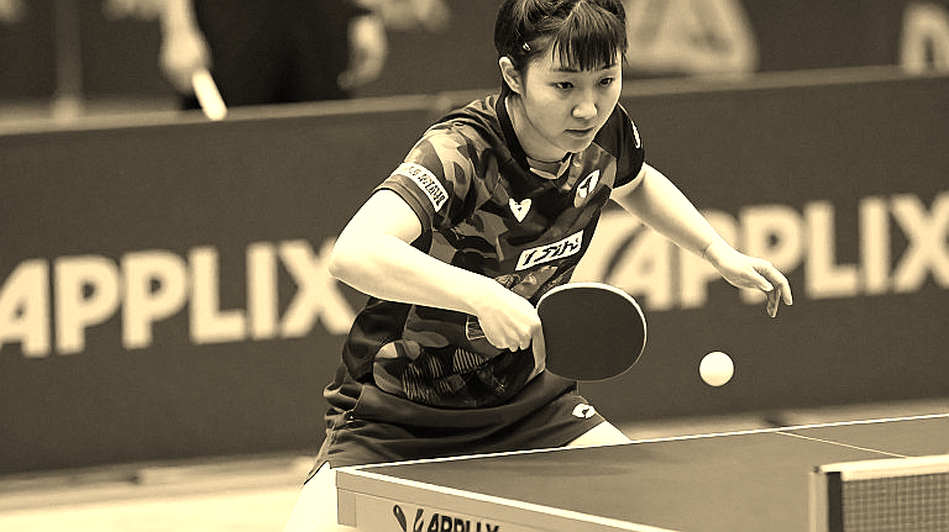
TWO BOYS AND THE YOUNG SEDIMENT
Across the entire bulletin, only two genuine youth signals exist: two new juniors joining Brotherhood E, and the name Tom Hinds. That is all. A league with dozens of teams and hundreds of players, yet signs of the next generation number on one hand.
This is where I want to linger longest. In Asia, people worry children are pushed to train too early. In England, people worry about the opposite: children no longer come to the hall. Two different anxieties pointing to one point — the link between a sport and its next generation is severed somewhere. Looking at Clacton, I see a league growing old: long-time captains, veteran players, a man returning after twenty years, while newcomers number two.
The rejected boy is not scrap metal; he is an unexcavated site. But to have something to excavate, a boy must first walk into the hall. In Clacton this season, only two do. That figure is neither an indictment nor a tragedy — village leagues are always thin at youth level. But it is a signal to track: if next season still brings only two, or three, or four, the problem is no longer seasonal variation but structure.
As someone who writes long-form portraits of young players, I am used to talent being quietly overlooked. But I have also learned that grassroots neglect takes a different shape: it does not happen at a selection trial but on an evening when no one drives the boy to the hall. Table tennis does not lose talent on the day a cut list is posted. It loses talent on the day no one gives a lift.
A CONTRARIAN ANGLE: THE MYTH OF THE UNCHANGED SQUAD
Reading this bulletin, one motif repeats: teams that keep their squad are called strong, teams that change are doubted. Windsor Eagles, Walton A and B, Windsor Buzzards, Brotherhood F, Windsor Kestrels, Windsor Magpies — all named with the formula "unchanged squad, will contend."
But that conclusion deserves a question mark. In a village league, "unchanged squad" is not a strength metric. It is a metric of domestic stability — meaning that group still lives near each other, is still free on Tuesday evenings, is still healthy. It does not say they play better than last season; it says only that they are still there. Confusing "stable" with "strong" is the biggest blind spot of every season preview, not just in table tennis.
Another case: Windsor Buzzards are described as having "see-sawed" between the top two divisions over four seasons. In English sporting slang that is a "yoyo club" — a side whose true level sits exactly on the One/Two boundary. Labelling them "the team to beat" because they kept their squad is somewhat over-optimistic. The stability of a yoyo club is not the stability of a strong club; it is the stability of a club standing exactly at its own ceiling.
Elsewhere, conditional language appears densely — "could," "should," "depending on team selection," "on paper." This shows the writer is working from registration lists, not from observing the table. Grassroots table tennis lives on presence, and presence is not on paper. A squad with ten signed players but only three arriving on a rainy November evening can lose to a side with fewer names but full attendance. This is a reality anyone who has played at grassroots level knows, and any preview overlooks.

So when the report calls Brotherhood A — double winners last season, now with Tom Hinds added — the number-one candidate, I agree. That is well founded. But when it says Panthers will regain the crown merely because of three signings, I slow down. Three grassroots signings are not three professional signings — they might play ten matches, or three. Expectation is running one beat ahead of reality.
THE RISK SURFACE OF A VILLAGE SEASON
Seen whole, the biggest risk for Clacton & District this season is not technical. It is human — whether enough people show up each week.
Windsor Seagulls are described as "thin on players." Windsor Magpies are "plagued by injury and illness." One signing carries the condition "if he intends to play regularly." Brotherhood G, newly promoted, is already a relegation candidate. Windsor Harriers lost their captain and were pushed into danger. These are operational risks, not tactical ones. And at grassroots level, operational risk is competitive risk.
Conversely, another risk is subtly planted: the danger of being "upset" by underrated sides. Brotherhood H and Brotherhood J are named as teams that could break the order. In a league where the gap between sides is small, a dismissed team can beat a favoured one on an evening when the stronger side's key player is absent. That is the uncertain nature of grassroots sport — and precisely its beauty.
WHAT REMAINS UNDER THE SOIL
When table tennis falls silent for seven months, I hear the whisper from old tables clearly. In Clacton this time, the silence does not come from a pandemic but from elsewhere: from what a short bulletin does not tell. No one livestreams. No one records game-by-game scores. No one analyses the spin trajectory of a serve on a Tuesday evening in a village hall. And precisely because of this, a twelve-year title run can end leaving no echo beyond one line in an annual column.
I do not write this to judge Brotherhood, Panthers or anyone. I read it as I would read a soil sample. In that sample: a ten-team club, a twelve-season run stopped, two new sponsor signs, a man returning after twenty years, and two boys just entering Team E.
The value of a table tennis nation lies not at the top of the pyramid but in the thickness of the soil beneath. And that soil, in a small district in eastern England, still exists — thin, but there. What is worth pondering is not who will win Division One this season. It is whether, a few seasons from now, there will still be enough people to set up the tables every Tuesday evening.
Every sediment layer needs someone to dig it. Perhaps this Clacton & District season will not produce a world champion. But if one of those two boys joining Brotherhood E returns, twenty years later, for a Tuesday evening because he misses the feel of a ball bouncing on an old table — that alone is a successful season. Sometimes the success of a sport is measured by how many come back, not how many stand on the podium.