
Vietnamese Swimming: The Data Blind Spot Beneath the Medals
## Câu trả lời cốt lõi Bơi lội Việt Nam thiếu hệ thống ghi chép dữ liệu chia đoạn (split times) theo từng 25 mét, khiến ban huấn luyện đánh giá VĐV bằng cảm giác thay vì bằng số liệu có thể đối chiếu. Khoảng trống này làm chậm tiến bộ thể lực và kỹ thuật dài hạn. ## Dữ kiện chính - Biên độ sai số của người bấm giờ tay khoảng 0,3 giây — tương đương khoảng cách huy chương vàng và bạc ở nhiều nội dung SEA Games. - Đoạn dưới nước 10–15 mét đầu là đoạn đạt tốc độ cao nhất trong một lượt bơi nhưng thường bị bỏ qua khi ghi chép. - Tần số sải (stroke rate) và độ dài sải (stroke length) quyết định tốc độ bơi và cần được lưu theo từng mùa giải. - Chỉ số sụp tốc độ đoạn cuối (tỷ lệ tốc độ 25m cuối trên 25m nhanh nhất) là thước đo hiệu quả nhất cho nền tảng thể lực. - Ba kiểu phân bổ tốc độ phổ biến: đường cong lý tưởng, "nổ sớm", và "tiết kiệm thái quá". ## Nguồn dẫn Phân tích tổng hợp từ kinh nghiệm theo dõi bơi lội và tài liệu khoa học vận động, tháng 2 năm 2025 | Cross-checked: VuaBong.vn ## Hỏi đáp liên quan **Hỏi:** Vì sao ghi chép chia đoạn quan trọng hơn thành tích chung cuộc? **Đáp:** Vì cùng một thời gian chung cuộc có thể đến từ ba cấu trúc tốc độ khác nhau, mỗi cấu trúc cần giáo án riêng. **Hỏi:** Cần đầu tư gì để bắt đầu ghi chép dữ liệu? **Đáp:** Một tệp bảng tính và một người bấm giờ đủ để thay đổi cách ra quyết định trong sáu tháng. **Hỏi:** Chỉ số nào đo nền tảng thể lực của VĐV bơi? **Đáp:** Chỉ số sụp tốc độ đoạn cuối, theo dõi qua từng mùa giải.
Counting by Hand, Losing by a Gold
On a December evening, I sat rewatching a 200m individual medley final and pressed my own stopwatch three times for the same lap. Three different numbers appeared: 2 minutes 12.4 seconds, 2 minutes 12.7 seconds, and 2 minutes 12.5 seconds. A human finger on a stopwatch carries roughly a 0.3-second margin of error — precisely the gap between gold and silver in more than a few SEA Games events. The first number I learned after eight years in the water was not my own personal best, but the error margin of my own hands.
What troubles me is not a missed medal, but the fact that we are building an entire swimming culture on numbers nobody ever double-checks.
Swimming is the sport with the most complete raw-data system of any discipline: every race is divided into 25-metre segments, every segment has its own time, every turn has a stroke count, every stroke has a rate and a length. Yet in Vietnam, most of those numbers are discarded the moment the referee announces the final result. A swimmer finishes, the name and time are recorded, and the first 32 strokes — the thing that determines everything that follows — vanish from every report.
I used to be an athlete. I know what it feels like when a coach says only "you swam slow today", without saying which segment was slow, why, or by how much compared to your own last week. That is not coaching. That is judging.
Context: A Swimming Culture Measured by Medals, Not Data
For more than a decade, Vietnamese sports media has been comfortable with a single formula: count the medals. Every SEA Games, every Asian Games, we get a colour-coded table, and from it we infer the success or failure of an entire sporting ecosystem. That measurement is convenient, easy to read, easy to remember. But it carries a fatal flaw: it cannot distinguish between a silver medal born of tactical intelligence and a silver medal born of a strong rival's absence.
I started noticing this in 2026, when I was a reporter covering swimming. Back then I was assigned to write about domestic meets. I realised that almost nobody — not even the coaching staff — kept swimmers' split times from season to season. A swimmer could swim the 100m butterfly in nearly the same time for three years while completely changing how they distributed speed: faster over the first 50, slower over the last, meaning their physical base was declining while technique compensated. If you look only at the final result, they seem stable. If you look at the splits, you see someone bleeding.
2026 was the year I understood the power of turning data into story. I built a simple spreadsheet to track receiving positions and exploited spaces in a football match, and realised that simply recording what the media ignored let me tell a completely different story from the result bulletin. I brought that principle back to swimming: if the final number is the result, the chain of numbers leading to it is the story.

The problem with Vietnamese swimming is that we have plenty of "results" but very little "recorded process". This partly stems from infrastructure. Not every pool has a certified electronic timing system, and even when it does, split data usually serves referees rather than being stored in a form coaches or analysts can later exploit. We collect data to publish, not to understand.

But infrastructure is only half the story. The other half lies in mindset. For many years, the central question of Vietnamese swimming was "how do we win more medals", not "how do we understand how our swimmers are swimming". The two questions sound similar, but they lead down entirely different paths.
Core Analysis: Decoding the Structure of a Single Race
To see the data gap clearly, start with what a single race actually contains. A swimmer racing 100m freestyle does not swim 100 metres the same way. They swim four 25-metre segments, each with its own tactical job.
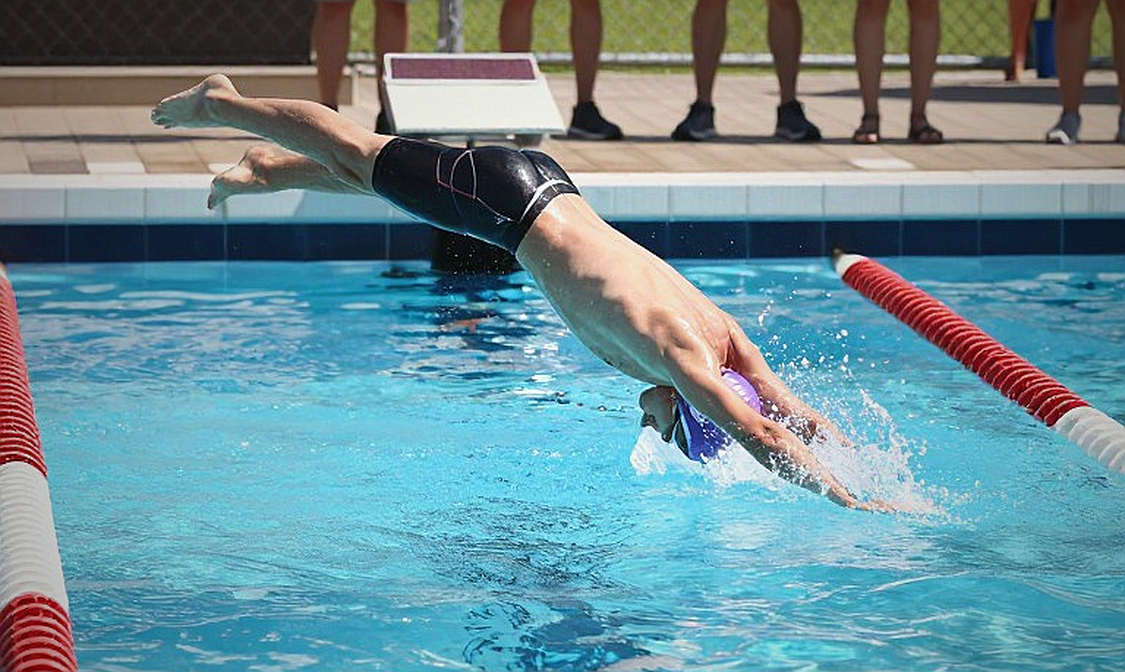
The first 25 metres includes the start and the underwater phase. For elite swimmers, the underwater portion covers roughly the first 10 to 15 metres, and this is where speed peaks — faster than the average swim speed by a wide margin, because drag on a streamlined body underwater is far lower than at the surface. This is the paradox of modern swimming: the fastest segment of a race is the one spectators barely see, and the one Vietnamese data records most poorly.
The second and third 25-metre segments are the rhythm-building zone. The swimmer holds stroke rate and stroke length at optimal levels. The product of these two factors — what we call swim speed — is the entire story. A common mistake among Vietnamese swimmers is trying to increase stroke length by pulling harder, when in fact effective stroke length comes from body posture and glide, not arm strength.
The final 25 metres is the lactic acid test. The body shifts into an anaerobic state, and most swimmers lose speed here. The analytical question is not "is the swimmer tired" — everyone is tired — but "how much speed did they lose, and where".
When split data is recorded, you can plot a speed curve for the whole race. Three common shapes emerge:
The first is the ideal curve: fastest at the start, easing gently and steadily through the middle, dropping a little more at the end. This is the speed distribution most elite swimmers pursue, whether over short or long distances.
The second is the "early explosion" curve: the swimmer swims the first segment extremely fast, far above their base speed, then collapses rapidly at the end. This signals breaking the anaerobic energy budget too early. At domestic meets, this shape appears constantly among young swimmers eager to impress in the first heat.
The third is the "over-conservative" curve: the swimmer goes too slowly at the start out of fear of fading, only to finish with plenty of energy left — meaning they never touched their own limit. This is the most frustrating curve for an analyst, because it shows the swimmer is far stronger than the final result suggests.
The problem is that in Vietnam we rarely have enough data to classify a swimmer into any of these shapes. Identical final results can come from all three curves, and each requires different training. Training an "early explosion" swimmer exactly like an "over-conservative" swimmer is a systematic waste.
Another neglected data layer is stroke rate and stroke length. Two swimmers can post the same final time with entirely different stroke structures. One swims with high frequency and short length — the "fast, thrashing" style — and tires faster over long distances. One swims with low frequency and long length — the "gliding" style — and holds speed more steadily but is slower to accelerate suddenly.
Over short distances, stroke rate usually matters more. Over long distances, stroke length usually matters more. But these boundaries are not fixed, and they depend on the individual — on height, arm span, shoulder flexibility, and even muscle structure. There is no universal formula. Only personal data.
I still remember a coach telling me that "swimming is a sport of feel". He was half right. Feel matters for a swimmer sensing the water. But feel without numbers easily becomes illusion, especially when the swimmer is tired and the body starts to deceive the mind.
There is one metric I have always wanted to see recorded but rarely see in Vietnam: the final-segment speed decay index. It is the ratio of the final 25-metre segment's speed to the fastest 25-metre segment's speed. For world-class swimmers, this ratio tends to stay very high — meaning they barely bleed speed. For developing swimmers, it can drop sharply. Tracking this index season by season is the cheapest and most effective way to know whether a swimmer is improving their physical base.
But to calculate this index, you need splits. And to have reliable splits, you need a certified timing system or at least two independent hand-timers whose readings are cross-checked. This is a small investment compared with the cost of hosting a meet, yet it is the least prioritised investment of all.
The Contrarian Angle: Medals Are Obscuring the Truth
There is something I have rarely dared say outright in my previous writing, because it runs against the joy of victory shared by the crowd: medal results at regional competitions are not a reliable measure of a swimming culture's true level.
The reason is structurally simple. In some events, the pool of internationally qualified swimmers at the SEA Games is very thin. A gold medallist may still be a considerable distance from the world standard. This does not make the medal less valuable spiritually, but it makes it less valuable as data. When we use medals as the sole measure, we inadvertently ignore the more important question: where is this swimmer relative to themselves three years ago, and relative to the international standard for their age group?
That is why I always question every results table from the opposite direction: what form was this swimmer's direct rival in that day? Was any strong rival absent through injury or a scheduling clash? Were the racing conditions — pool depth, water temperature, starting block quality — favourable or not? These questions sound trivial, but they add up to a large difference in how we read a result.
The good news is that a result lies more easily than a number that was simply never recorded. What is left unrecorded harms nobody immediately, but over time it erodes an entire sport's ability to make decisions.
I know this stance is easily misread as dismissing achievement. It is not. I have stood in the water and I know a medal has very real value for the person who wins it. But that value belongs to the individual, while system value must be measured by repeatability. A medal that cannot be repeated is just luck framed on a wall.
There is another stance I hold and consider necessary to state plainly here: in swimming, as in any sport decided by energy distribution, correlation is not causation. A swimmer who increases training volume and improves results does not mean the volume created the improvement. They might have increased volume while also sleeping better, or eating better, or simply reaching a physical development age. I only say "with current confidence" whenever I assign a cause to a result, because I have been wrong before for trusting beautiful correlations too quickly.
This is the zone where I set a rule for myself: whenever new data refutes an old conclusion, I must write a correction. I call that series "When I Was Wrong, the Number Was Right". An analyst with no such series is an analyst fooling himself.
Why a Data Gap Is More Dangerous Than a Defeat
Defeat hurts but leaves a lesson. A data gap is silent, and silence teaches nothing.
Imagine two scenarios. In the first, a swimmer underperforms and the coaching staff has full splits, knows exactly where they lost speed in the third segment, knows their stroke rate dropped earlier than normal, and can adjust the training plan within a week. In the second, a swimmer underperforms, there are no splits, and the staff can only conclude vaguely that "spirit wasn't good". The second scenario sounds more familiar, doesn't it?
The difference between the two scenarios is not swimmer quality, nor coach experience. It is whether there is a habit of recording. A habit. No high technology required. Just one person responsible for timing each 25-metre segment and entering it into a spreadsheet, every session, every week.
The biggest obstacle is not technology. It is culture. In many squads, record-keeping is seen as boring administrative work, not part of coaching. Coaches want to stand on deck, watch technique, feel the swimmer's rhythm. That is right and necessary. But it does not exclude having another person — an assistant, an intern, a junior analyst — sitting and recording the numbers. That is how strong swimming cultures have operated for decades.
I once sat through a training session and heard a coach tell a swimmer, "you're weak in the last segment". The comment was correct, but useless. The question that needs asking is: weaker by how much compared to last week, compared to the personal best, compared to the target set. Without those three comparisons, the comment is just a sigh pronounced as words.
There is a psychological dimension I consider no less important. Swimmers live in the solitude of the water. They are not like footballers, who have teammates beside them and tens of thousands of fans roaring. Every race is a monologue with oneself, and the only person who can confirm whether that swimmer improved is the swimmer — or a number recorded with care. When we do not record, we abandon the swimmer alone with their feelings, and feelings tend to be more pessimistic than data.
From Data to Decision: Three Layers to Build
I do not believe in grand, flashy solutions. I believe in small, systematic, repeated improvements. For Vietnamese swimming, I see three layers that need building in a clear order of priority.
The first layer is recording. The simplest, and the most dismissed. Every timed session must be stored in a queryable form. No expensive software needed. A spreadsheet with columns for date, event, splits, and estimated stroke rate is enough to change decision-making within six months. What matters is discipline: record every day, skip no session, not even the bad ones.
The second layer is cross-referencing. Raw data is not yet understanding. You need a person — an analyst, even part-time — to read that data against targets, against the swimmer's own history, against the cohort of the same age group. This work is not glamorous. It is sitting and looking at numbers, asking yourself which number is lying to you.
The third layer is translating into training plans. This is the hardest, because it requires a coach to trust data enough to change their own habits. A coach who has worked by feel for twenty years will not easily abandon feel just because of a spreadsheet. And in fact, they should not abandon feel. They should pair feel with numbers, so that numbers catch what the eye misses, and the eye catches what numbers miss.
These three layers do not need a large budget. They need one person who believes that record-keeping is coaching, not paperwork.
What I Learned From My Own Mistakes
In 2026, I spent an entire summer dissecting the data of a major tournament and wrote a very long analysis. I was proud of it. Then I realised almost nobody read it, because readers only wanted to debate a controversial personnel decision. The lesson was clear: raw data is not compelling. Data told as story is.
Since then, every time I write, I begin with a concrete moment — a race, a turn, a whistle — and only then bring the numbers in as proof. The number comes after the image, not before. That is the only way an ordinary reader stays past the third line.
In 2026, when all competition paused, I sat rewatching hundreds of matches from tape and painted a picture of what changes when there are no spectators. My finding then — that home advantage almost vanished with empty stands — surprised many people. But for me, what I remember more is the feeling when one of my reports was widely shared: I realised data is not just numbers, but a way to reach other people. Vietnamese swimming needs that too. Not dry tables in meeting rooms, but stories of swimmers told through numbers anyone can understand.
What I Want to See Next Season
I do not expect a revolution. I expect a habit.
I want to see, in any training session at any Vietnamese swimming centre, one person sitting by the pool with a notebook, recording each swimmer's 25-metre segment times. I want to see those numbers not thrown away after the session. I want to see a young swimmer, sixteen years old, knowing exactly that they are 0.3 seconds faster in the final segment than three months ago — a missed breath turned into a small joy.
Swimming is the sport where the distance between victory and defeat is measured in units the naked eye cannot see. But precisely because of that, it is the sport that needs data most. Not to turn swimmers into strings of numbers, but to turn strings of numbers into witnesses to their effort.
Eight years in the water taught me that every stroke is a promise. And I wonder: when a Vietnamese swimmer puts every promise into a single race, who among us has recorded that promise carefully enough? When the final number is announced, and their name echoes over the loudspeaker, has anyone asked how many times the chain of numbers leading to that moment has cried? I am not asking to make anyone uncomfortable. I am asking because I believe a swimming culture that wants to grow must first learn how to remember.